Sunday, 22 April 2012

Nepal 2012

Over the Songkran holiday, Eunice and I went to Nepal for ten days with other staff from Patana and had a fantastic holiday.  Most of the others went off and did their own trek but Bridget joined with us. The country was breath-taking and the local people so kind and generous that it make it, undoubtedly, a country to which we would like to return at some point in the future.  There remains so much of this fascinating country still to explore.
We flew into Kathmandu and spent the first few days exploring the city which is full of narrow alleys, chaotic traffic and religious artifacts hidden around every corner. Next we took at taxi over the winding roads of the foothills of the Himalayas to Pokhara.  Here we met with Surya, a local birder with a passion for raptors, who Bob had put us in touch with.  He turned out to be the most kind and thoughtful host anyone could possiblly want to meet, guiding us through the mountains and showing such generousity with both his time and knowledge as well as introducing us to three generations of his family including his charming wife and grandaughter.  Thanks Surya, we owe you one!

The birding was great and I have included a selection of the better shots.  This Brahminy Starling was nesting in the middle of Pokhara although Chestnut-tailed were more common.

Verditer Flycatcher were everywhere and were very vocal with their sweet but slightly discordant song.
We found a number of flycatchers but this was the only Little Pied Flycatcher we saw.


On the journey from Kathmandu to Pokhara we saw this Woolly-necked Stork.  It turned out to be the only one of the trip as well!

Surya had arranged for us to visit a 'Vulture Restaurant' near to Pokhara.  Since it cannot be used as food, when a cow dies the local raptor group are given the carcass to dispose of.  They skin it then put the carcass out for the vultures who collect in their dozens to get a free meal. There are a number of feeding sites around Nepal so if you are birding out there then get in touch.  The work the raptor groups are doing is fantastic and a generous donation is all they ask.  As a result, the numbers of vultures are increasing, some species being globally threatened.  We saw numbers of both Red-headed and White-rumped as well as the expected Griffon Vultures.
Do you see what I see?  Is that lunch arriving?
The vultures loped along the path after the cart carrying the dead cow only a few feet away from the men pushing it.  It had hardly been dropped on the floor when they piled in with unceremonious greed.  Not a place to fall asleep on the job I think.
A lone White-rumped Vulture wanders round looking for an opening in the seething mass of the bigger Griffon Vultures.
This Red-headed Vulture waited in a tree but still managed to get a full meal.  The site is brilliant, based in a deep canyon with the snow capped Annapurna range towering up as a backdrop.
After eating the vultures then take to the sky and fly around or chill on the boulders nearby.  Surya told me that they don't need to eat for another week or so.  The flight identification is easy with such good views, this one is adult White-rumped with a young bird in the photograph below.
I think the bird below is a Eurasian Griffon judging by the dirty underwing and the shorter tail.  Adult Himalayan have a cleaner underwing and immatures have a darker one. 
Surya organised and joined us for a trek into the Annapurna range starting at Nayapul, then moving to Ghorepani, across to Ghandruk and returning back to Nayapul.  We also had the services of an excellent porter called Budi who began to get really interested in birds.  He would be a real asset for any birders wanting to trek in the area.  He has excellent eyes and is quick to spot birds and very happy to point them out.  Surya, Budi and I went out birding for an hour or so every morning and evening after we had finished the main trek! 

It was on one of these evening excursions that I heard a bird that sounded like a Song Thrush but repeated it song three times not the usual two.  It turned out to be this White-collared Blackbird.
I think this is Rufous-breasted Bush Robin.  Smart bird anyway.
We climbed up Poon Hill for the early morning sunrise.  Well worth the effort to see the mountains but also the birding was great at the top.  Lots of birds in the first few hours of light including plenty of Rufous-naped Tit, Olive-backed Pipits and Mountain Bulbuls.  Fire-tailed Sunbird were obvious and loads of Rosefinches and Laughing Thrushes.  Budi was concerned about being out on my own as he believed there were still wild tigers nearby.
This flock of Curlew migrated through the mountains heading north.  It was freezing cold and low cloud swirled around the mountains and I was filled with admiration at their efforts.  It was quite special seeing them fly past at 4500metre up.
Also at the top of Poon Hill were a number of Collared Grosbeak. 
The rhododendrons were fantastic, their vivid reds looking like spots of blood against the snow capped mountains.  Whole hillsides are carpeted in their blossoms at this time of year.

Brightly coloured prayer flags flutter in the cool breeze. 
Everything bird I have posted seems to start with the word Rufous so here is another, Rufous-breasted Accentor, again at the top of Poon Hill.

So far, I am half way round the trek and will post some pictures during the coming week.

Saturday, 24 March 2012

Bang Pra and Khao Yai


Two main birding highlights of March were a trip to Bang Pra non-hunting area which is near Chonburi and our second visit to Khao Yai. Bang Pra needs to be visited early in the day and we were a bit late but a couple of Chinese Francolin were calling madly and there were some great views of Oriental Reed Warbler and Rufous Treepie. The best bird was a very obliging Yellow-eyed Babbler.


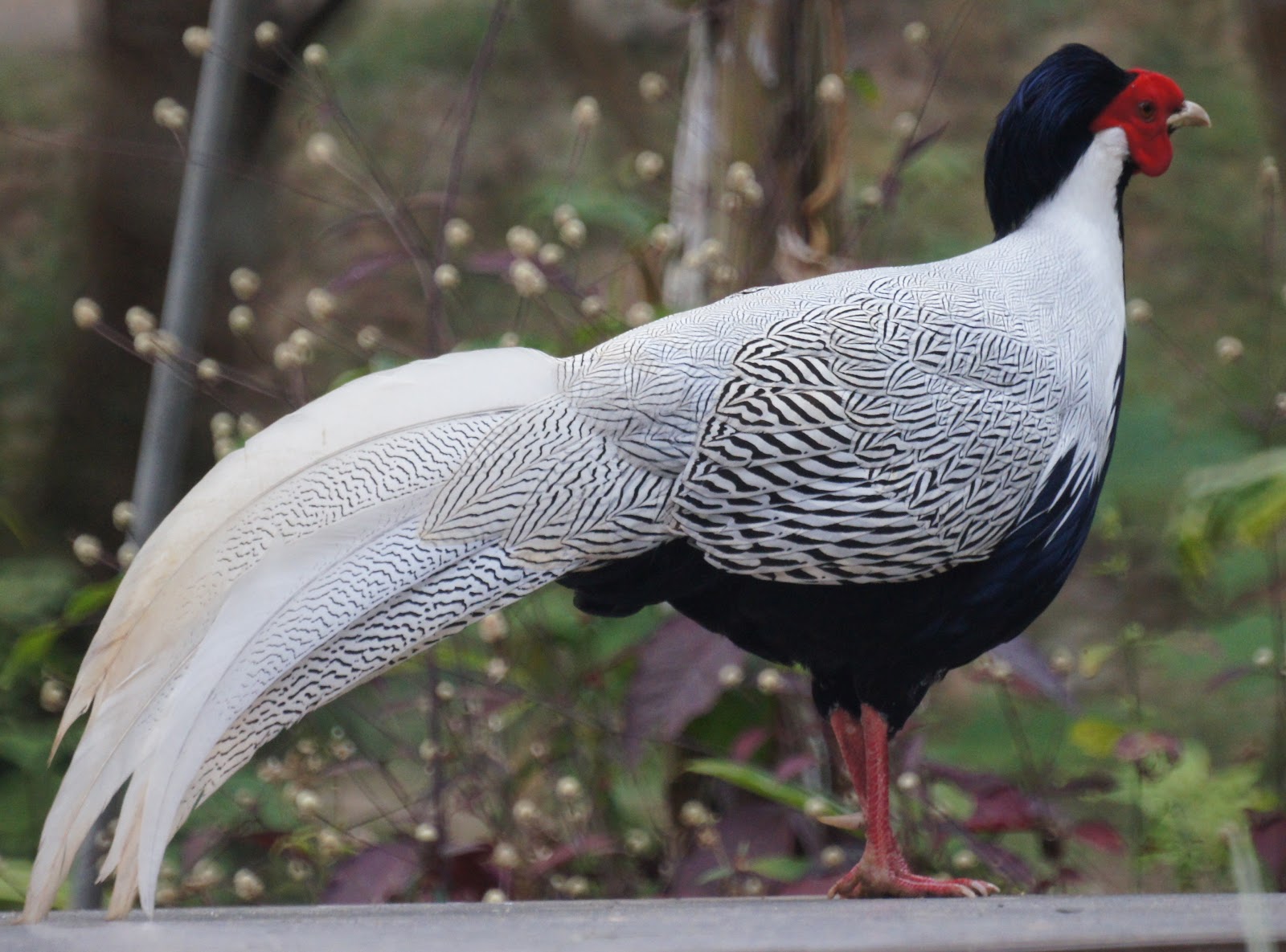
 The trip to Khao Yai was fairly easy being about thrre hours north east of Bangna.  Traffic was heavy but moving so it was about 7.00 on Friday evening when we arrived.  The hotel (Eco Valley Lodge) was a major disappointment being too far out and not very clean.  However, the following day we went into the park and had great views of Moustached Barbet.  It was noticable that the birding tailed off by 10.00 so being a distance from the park entrance was not helpful.. I think we will camp next time.  The park was fairly busy being a weekend but there were still birds to be found.  Good views of Slaty-backed Forktail and Oriental Pied Hornbill.  In the evening we went to the radar station for a second time to look for Siamese Fireback.  No luck with the Fireback but two male and two female Silver Pheasant showed really well. 

The following day we managed to get into the park a little earlier and tried the radar station road for a last time and had great views of two male Siamese Firebacks.  Eunice took this stunning shot.  
We went found some different trails and one ran beside a river.  Very beautiful, relaxing and relatively cool.  Bangkok is really hot at the moment.  Some good birds with Hill Myna, Slaty-backed Forktail, Green-billed Malkoha and Crested Serpent Eagle to name but a few.
 On the way to the radar station we found a board wlk that opened out into this spectacular view.  A couple of Wreathed Hornbill flew past as we looked over the valley.

Saturday, 25 February 2012

Doi Chiang Doa and Bueng Boraphet


It only seems a short time ago since we were back in school after the Christmas break having seen some excellent birds throughout Thailand with Richard and Gaynor.  We had been especially impressed by the mountain of Chiang Dao and the nearby Malee Nature Lover's Resort.  The name does no justice to the place! Eunice and I decided to drive north this time and stop at Beuang Boraphet near Nakorn Sawan in search of duck.  It is the largest natural freshwater lake in Thailand.  We hired a boat for three hours, which cruised across the water and took us close to some excellent birds.


Purple Swamphen is a common bird here which tries to get at the fish inside the fishermen's nets.  Unfortunately, they can get in but not out.  Our boatman worked for the Parks Department and released as many as he could find as we cruised the lake.

I even got the chance to handle one myself.


We came across a big flock of Glossy Ibis which took to the air in an impressive show of iridescent plumage.


At last we caught up with both male and female Siberian Rubythoat
which showed really well eventually.

  Why is it that I seem to struggle to see Coot wherever I go?  At last, what a mega!

So on to Chiang Dao which took a total of nine hours driving to reach from BKK.


It was worth it with good views but bad photographs of both male and female Hume's Pheasant, Rufous-flanked Scimitar Babbler and a very obliging flock of Spot-winged Grosbeak to name but a few highlights.


Another day we pressed further north to Doi Ang Krang which is up against the Myanmar border.  Frank got shelled when he visited 15 years ago in a dispute between the Thais and Burmese but we had no such trouble, although I am told it still happens from time to time.


The main problem is the loss of habitat created by extensive burning of the forest for clearance.  The air was thick with smoke that stung the eyes and caught in the throat.  As evening drew on it reminded me of the 19century folk songs that describe the furnaces of Sheffield and liken it to hell.  We were told the reasons were twofold, to clear the undergrowth to encourage the lucrative growth of mushrooms and to create a firebreak.  Well they are certainly succeeding with the latter.


Despite the destruction, there are some areas of forest which remain untouched and we discovered good birds such as this Red-faced Liocichla and a very obvious Scaly Thrush which was being spooked by a Changeable Hawk Eagle hanging around in the trees nearby.

Back to Doi Chiang Dao for a second trip up the mountain.  You have to start very early, about 5.30, and drive up very rough tracks to the mountain.  This takes about an hour but you arrive just as the day is breaking and hear the forest come to life around you.  There is rarely anyone else about and the tranquility is almost religious.
Flycatchers put in a great showing with Rufous-throated Flycatcher and the male slaty-backed Flycatcher showing particularly well.


As always, I end up with some female flycatchers to identify at a later date.  Anyone any thoughts on the one below?  I think it could be Slaty Blue Flycatcher or Slaty-backed Flycatcher but any comments gratefully received.  It looked quite a bit smaller and darker than the Slaty-backed I've seen before.


Spot-winged Grosbeak was a surprise beside the Sub Station but when I read through the records it has been fairly regular here.

I put this one in for you Gaynor.  Just at the entrance of the Wat.


Flycatchers again.  Anyone any thoughts?  It looks like one of the Blue Flycatchers but I wondered if it is a Leucistic male?


We visited the Wat a number of times and this bird never showed until our last day.  We turned a corner and there it was, walking about the monks quarters as if it owned the place!

On the way back we stopped at Boraphet again and saw loads of Pied Kingfisher.


Friday, 3 February 2012

More Raptors

This time we managed to connect with the Raptor Festival near Petchaburi.  Despite there being loud music belting out 'Country Roads' and hits by, very appropriately, The Eagles, there were loads of birds of prey in the area.  Good views of Steepe Eagle, another Imperial Eagle,  dark phase Booted Eagle and a couple of surprises, two Black-headed Ibis over and a Watercock on a nearby flooded rice paddy.


The local teachers enjoying letting their hair down with some performances of Thai favourites.  Their students watched with obvious admiration and were later brought up to be presented to us to practise their English.  It's not all beer and sandwiches being a student you know.
Two Black-headed Ibis were drawn to the sound of Neil Young's After the Gold Rush and, not being able to believe their ears, came to have a closer look.
This Steepe Eagle gave some good views.


As did this dark phase Booted Eagle.  At one point it folded its wings back and plunged like a stone towards the ground causing the local bird population to scatter in panic.  Had me going as well!


This week's winner of the Hide and Seek prize is this Watercock.

Saturday, 21 January 2012

Raptors near Petchaburi

This weekend we went to an area north of Petchaburi which has a fabulous concentration of raptors over the winter.  These include Pied and Eastern Marsh Harriers,  Black, Brahminy and Black Shouldered Kites and Greater Spotted, Steppe and Imperial Eagles.  It is a 1.5 hour drive from Bangna.  The views of the eagles were spectacular with at least five Greater Spotted, two Steppe and an Imperial Eagle showing really well.
 Black Kite (Black-Eared Kite)
 Greater Spotted Eagle
 Juvenile Imperial Eagle.  This bird flew so close to us and could be seen looking intently at us it circled.
 Steppe Eagle
 A view across the rice fields.  A month ago these fields were filled with rice and now the rice has been harvested and the stubble is being burned.  This tree was full of Black Kites first thing in the morning with at least twenty filling the branches.
Two Steppe Eagles showing their size variation